A cohesive collector coin series gives every piece a shared promise and a distinct chapter. Start with one idea, decide what repeats, and map how each issue advances the set. The result reads as a collection rather than unrelated designs under one name.
This is a guide to the creative architecture of a series, not a production brief or a claim about rarity. For broader context, the Collector Notes guides explore collector-led releases from several useful angles.
Start with a series promise, not a list of designs
A useful starting point is a sentence explaining what unites the issues. It should name the subject, point of view, and recurring experience. “Coastal lighthouses at different points in the day” is stronger than “a lighthouse series” because it identifies both what can repeat and change.
Borrow an interpretation principle. The National Park Service describes primary interpretive themes as key ideas connecting individual resources to larger meaning (National Park Service). Your promise supplies the larger meaning; every issue contributes to it. If a design cannot be explained through that promise, it may belong in another collection.
- Can a reader describe the series in one sentence without naming a specific issue?
- Would a new issue still make sense if viewed beside the first one?
Choose what stays fixed and what deliberately varies
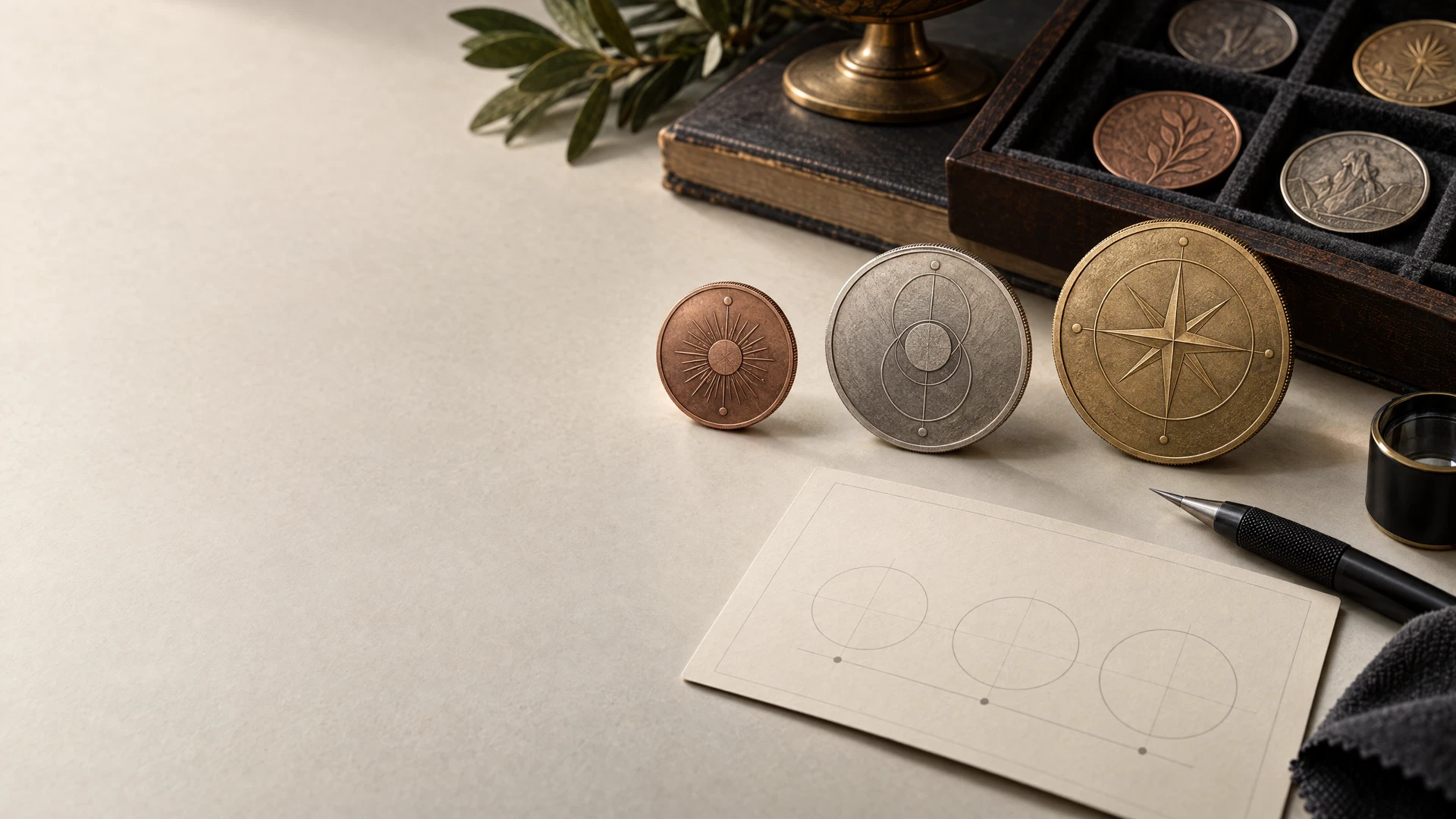
Cohesion needs recognizable anchors. Select a few: overall mood, border logic, type treatment, reverse convention, title treatment, or a series mark. Too many produce near-copies; too few feel accidental.
Then identify variables—location, character, era, central image, or point in a story—while retaining the shared grammar. A continuity matrix makes the distinction clear: fixed elements say same world; variable elements give each piece a job. It is creative planning, not a commitment to a format or finish.
- Fixed: series title, framing approach, typography family, and a recurring identifying detail.
- Review rule: a thumbnail should feel related; a close look should reveal something new.
Give the sequence a beginning, middle, and finish
A series benefits from an order even when each piece stands alone. Sketch an opening that introduces the language, a few designs that broaden the theme, a change of pace, and a closing idea. You need not lock every future design, but the next design should have a role.
The American Numismatic Association distinguishes type from set collecting, which can mean collecting all years and mint variations (American Numismatic Association). For a creator-led collector coin series, define completeness narratively: a journey, historical moments, or a cast of characters. A collector should understand the relation without scarcity language.
- Opening: establish the world and the repeated identifiers.
- Development: add contrast without abandoning the promise.
- Closing: return to the central idea with a sense of resolution.
Design for both the single piece and the group view
A collector meets a series singly and as a group. Test both. Each design needs a focal point and readable image-title-detail hierarchy. In a group, those elements should create rhythm, not noise. A repeated frame, title placement, or emblem can link the series without identical compositions.
Use a wall test: arrange rough thumbnails in a row and step back. Notice duplicates and designs that look like another project. The Royal Bezel Series is a useful internal example of a recurring bezel-inspired direction framing varied expression. Identify the organizing device; do not copy the template.
- Check the layout in thumbnail form and at closer viewing size.
- Avoid repeating a central image merely because a prior issue worked.
- Reserve one visual surprise per issue, while keeping the anchors recognizable.
Create a collector record while the ideas are fresh
Keep a consistent record for each issue: title, sequence position, subject, rationale, and connections to earlier or later pieces. That preserves reasoning and makes a sequence easier to follow.
Public coin programs also explain their sequence. The U.S. Mint's Charters of Freedom Platinum Series names its founding document for each year (U.S. Mint). A collector-led project can borrow that clarity with a repeatable note. For project-specific details, see custom project planning.
- Series title and one-sentence promise.
- Issue title, place in the story, and the subject represented.
- A short note on the recurring element and what changes in this issue.
Review the whole collection before advancing the next chapter
Before moving to the next design, revisit the promise, the continuity matrix, and the group thumbnail view. Ask whether the proposed issue expands the story or simply repeats a familiar image. If the answer is unclear, revise the subject, change the point of view, or save the idea for a different collection.
Cohesion does not mean uniformity. It means that every decision can be traced back to an intelligible shared idea. When theme, visual grammar, sequence, and documentation agree, a collector coin series feels considered from its first chapter onward.
Frequently asked questions
How many designs should I plan before beginning a collector coin series?
Plan enough to prove the theme has range: an opening concept, a few contrasting directions, and a possible conclusion are often sufficient. Leave room to refine later ideas, but do not begin with only one design and hope a series appears around it.
Should every issue in a collector series look nearly identical?
No. Near-identical designs can flatten the experience. Keep a small group of recognizable anchors, then vary the featured subject, composition, or story point so each issue adds information rather than repeating the last one.
What makes a series theme strong enough to support multiple issues?
A durable theme has a clear point of view and several natural chapters. Test it by listing distinct subjects that fit the promise. If those subjects immediately feel repetitive or unrelated, narrow the idea or find a more specific organizing concept.
Do I need to decide every future release detail at the start?
No. Decide the purpose, the design anchors, and the broad sequence first. Future creative choices can remain flexible as long as they are checked against the series promise and recorded consistently.
A project conversation
Have a collector series concept worth pressure-testing?
Once the theme, visual anchors, and first chapter are clear, Hart Strike Mint can review the concept in the context of a collector-led metal project. Bring the story and references you have; remaining project-specific details can be discussed if the direction is a fit.
Start a project reviewClosing perspective
A cohesive collector coin series is built from a shared promise, not from repeated decoration. Establish the idea that holds the set together, set a few reliable design anchors, and give each issue a distinct role in the sequence.
Document the decisions as you go and review the collection as a group before adding the next chapter. That discipline keeps a series readable, flexible, and rewarding to follow without turning its story into a claim about future value.